
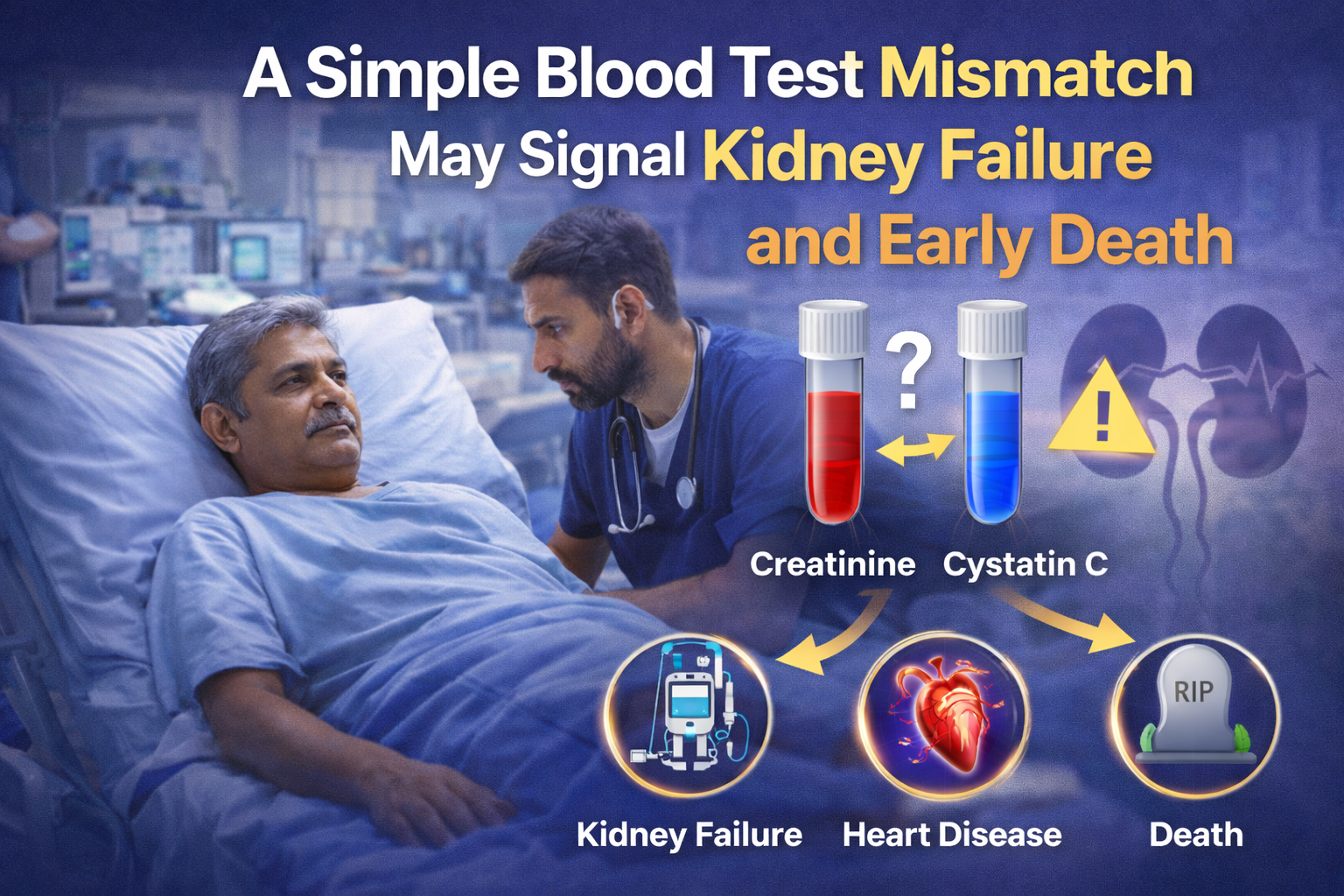
Most people believe a single blood test is enough to check kidney health. However, new international research suggests that relying on just one kidney test may quietly miss serious warning signs.
According to a large global study, a mismatch between two common blood tests—creatinine and cystatin C—can strongly predict kidney failure, heart disease, and even death, especially in older or hospitalized patients.
🩺 What Are These Two Kidney Blood Tests?
🔹 Creatinine
Traditional and most commonly used test
Comes from muscle breakdown
Affected by:
Muscle mass
Age
Nutrition
Body size
🔹 Cystatin C
A newer, more sensitive marker
Produced by all cells in the body
Less affected by muscle mass
Better reflects true kidney filtration in many people
👉 Both tests estimate kidney function (eGFR), but they don’t always give the same result.
⚠️ Why a Mismatch Is Dangerous
Researchers found that when cystatin C shows worse kidney function than creatinine, it is not harmless.
Key findings:
Over one-third of hospitalized patients had a major mismatch
Cystatin C often showed kidney function 30% worse than creatinine
These patients had:
Higher risk of kidney failure
Higher risk of heart disease
Higher risk of death
This means creatinine alone may falsely reassure patients and doctors.
🌍 How Big Was This Study?
This was one of the largest kidney studies ever conducted:
860,000+ adults
From multiple countries
Followed for an average of 11 years
Included healthy individuals, hospitalized patients, and elderly people
The findings were consistent across populations.
💊 Why This Matters for Medicines Too
Kidney function determines safe dosing of many drugs, including:
Antibiotics
Cancer medicines
Diabetes medications
Painkillers
If kidney function is overestimated:
Drug toxicity risk increases
Side effects become more likely
Hospitalizations rise
Accurate kidney testing is not just about diagnosis—it’s about safety.
👵 Who Is at Highest Risk?
This blood test mismatch is more common in:
Older adults
Hospitalized patients
People with chronic illness
Cancer patients
Obese individuals
Smokers
Even apparently healthy people may show this mismatch.
❗ Why Cystatin C Is Still Underused
Despite international recommendations since 2012:
Fewer than 10% of labs routinely used cystatin C (until recently)
Many doctors still rely on creatinine alone
Access is improving, but awareness is low
Experts warn that valuable early warnings are being missed.
👨⚕️ Doctor’s Advice for the Public
You should consider both tests if:
You are above 60
You have diabetes or BP
You are hospitalized
Your kidney reports fluctuate
Medicines affect your kidneys
Ask your doctor:
“Should cystatin C also be checked?”
✅ Key Takeaway
When creatinine and cystatin C don’t agree, the risk of kidney failure, heart disease, and death rises sharply.
One blood test may not tell the full story.
Early detection can prevent dialysis, transplantation, and serious complications.
⚠️ Medical Disclaimer
This article is for public awareness only. Laboratory tests and medical decisions should be made in consultation with a qualified doctor.
📚 Study Reference (Short)
Estrella MM et al., JAMA (2025).
Discordance in Creatinine- and Cystatin C–Based eGFR and Clinical Outcomes.
DOI: 10.1001/jama.2025.17578


Leave a Reply